


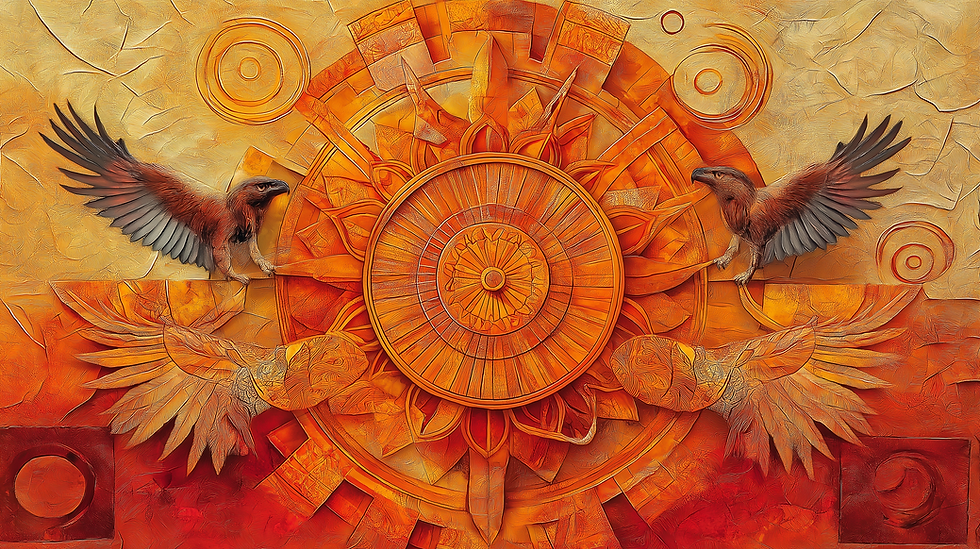
The Sun God


The Sun God isn’t viewed as a distant, all-powerful deity, but as a vital force that practitioners can connect with directly through nature. His yearly cycle is seen as a metaphor for personal growth cycles, inspiring practitioners to align their lives with natural rhythms.
Practitioners are encouraged to develop a personal relationship with the Sun God through mindful sunbathing, solar-gazing at sunrise or sunset (with appropriate safety precautions), or simply by taking time to appreciate the sun's warmth and light. This relationship is seen as nurturing personal vitality, clarity of purpose, and the ability to bring one's gifts into the world.

The Sun God
Nature and Attributes
The Sun God represents the life-giving power of the sun. He embodies light, warmth, vitality, and the active principle in nature. Unlike some ancient solar deities associated with war or domination, this Sun God is primarily linked to growth, inspiration, and the cyclical nature of life.
Seasonal Associations
- Strongest presence from spring equinox to autumn equinox
- Reaches peak power at the summer solstice
- 'Reborn' at the winter solstice as the days begin to lengthen again
Magical Associations
- Invoked in spells for energy, vitality, success, and clarity
- Associated with fire magic
- Used in rituals for self-confidence and personal power
Relationship to Other Figures
- Often seen as a consort to the Earth Mother or Moon Goddess
- In some interpretations, might be viewed as the son/lover of the Earth Mother, dying and being reborn each year
- Father to various nature spirits in some mythologies
Personal Work
- Meditation practices focusing on personal growth and self-actualization
- Using sunlight for healing or energy work
- Aligning daily routines with the sun's cycles for improved wellbeing
Iconography and Symbols
- Often depicted as a radiant male figure, sometimes with a solar disk or crown
- Associated with gold, yellow, and orange colors
- Symbols include the wheel, spirals, and sunflowers
- Sometimes represented by animals like lions, eagles, or horses
Rituals and Celebrations
1. Summer Solstice (Litha): The main festival honoring the Sun God at the height of his power. Rituals often involve:
- All-night vigils to watch the sunrise
- Bonfires to represent the sun's energy
- Sun wheels rolled down hills or floated on water
- Feasts featuring round, golden foods
2. Winter Solstice (Yule): Celebrates the 'rebirth' of the sun. Rituals might include:
- Lighting candles or fires to 'call back' the sun
- Burning Yule logs
- Decorating with evergreens to represent enduring life
3. Daily Practices: Some practitioners might greet the sun each morning with a short prayer or offering
Ethical Implications
- Inspires action, initiative, and the courage to stand up for one's beliefs
- Associated with honesty and truth (bringing things to light)
- In modern contexts, might be linked to solar energy and sustainable power
Modern Interpretations
- Sometimes linked with scientific understanding of the sun's role in the ecosystem
- Might be seen as a metaphor for the conscious, active self in psychological work
- Could be associated with renewable energy movements
